> ## Documentation Index
> Fetch the complete documentation index at: https://docs.omnifact.ai/llms.txt
> Use this file to discover all available pages before exploring further.
# Editing Your Messages
> Learn how to modify your messages after sending them to improve your conversation with Omnifact
export const Glossary = ({children, term}) => {
const glossaryDefinitions = {
'ai': 'Artificial Intelligence - computer systems that can perform tasks typically requiring human intelligence',
'artificial-intelligence-ai': 'Computer systems that can perform tasks typically requiring human intelligence',
'ai-assistant': 'An AI system designed to help users with tasks through conversation',
'space': 'A dedicated environment with a specialized AI assistant and optional Uploaded Files',
'spaces': 'Dedicated environments with specialized AI assistants and optional Uploaded Files',
'knowledge': 'The sub-menu in Space settings where you manage Uploaded Files and Connected Sources',
'uploaded-files': 'Documents manually uploaded to a Space under the Knowledge tab',
'prompt': 'Instructions or questions you give to an AI assistant',
'response': 'The AI assistant\'s answer to your prompt or question',
'query': 'A question or request for information',
'context': 'Background information that helps the AI understand your request',
'llm': 'Large Language Model - an AI system trained on vast amounts of text data to understand and generate human language',
'large-language-model-llm': 'An AI system trained on vast amounts of text data to understand and generate human language',
'privacy-filter': 'A system that automatically detects and masks sensitive information before it reaches AI models, and restricts images from being sent to non-EU hosted models for compliance',
'chat-instructions': 'Custom guidelines that define how an AI assistant behaves and responds in a Space',
'pattern-matching': 'The process by which AI recognizes and uses patterns in data to provide responses',
'patterns': 'Recognizable structures or trends in data that AI systems can identify and use',
'training-data': 'The text and information used to teach an AI system how to understand and respond to requests',
'natural-language': 'Everyday human language that people use to communicate, as opposed to computer code or formal syntax',
'hallucination': 'When an AI generates information that sounds plausible but is actually incorrect or fabricated',
'filtering': 'The process of automatically detecting and temporarily replacing sensitive information to protect it during AI processing',
'masking': 'Temporarily replacing sensitive information with generic labels to protect it from being seen by external AI models',
're-insertion': 'The automatic process of putting original sensitive information back into AI responses after they\'ve been generated with filtered data',
'retrieval': 'The process of finding and accessing relevant documents from Uploaded Files to answer questions',
'hosting': 'Where an AI model is deployed and made available for use - either by third-party providers, on your organization\'s own servers, or in private cloud environments',
'cite': 'To reference or mention the source of information, helping you know where an AI\'s answer came from',
'sidebar': 'A panel that appears on the side of the screen showing additional information and options',
'toggle': 'A button or control that switches something on or off, like opening and closing a sidebar',
'navigation': 'The system of menus and buttons that help you move between different parts of Omnifact',
'favoriting': 'Marking a Space as a favorite to pin it to the main navigation for quick access',
'pinning': 'Attaching a Space to the main navigation bar so it\'s always visible and easily accessible'
};
const definition = glossaryDefinitions[term];
return {children};
};
Omnifact gives you the flexibility to edit your messages after you've sent them. This feature is invaluable when you want to correct typos, clarify your question, or refine your prompt to get better results from the AI assistant.
Think of message editing as your "second chance" button. It allows you to refine your prompt without starting over, helping you maintain conversation context while getting more precise and helpful responses.
## Why Edit Your Messages?
There are several scenarios where editing a message can be helpful:
Correct mistakes that might lead to misunderstandings or inaccurate
responses.
Make your request more specific when the initial response doesn't address
your needs.
Improve the wording of your message to get more targeted and useful
responses.
Include important information you forgot to mention in your original message.
## How to Edit Your Messages
Editing a message in Omnifact is straightforward:
 Find the "Edit" button in the top right corner of your message. This
button appears on your messages after they've been sent.
Click the "Edit" button to transform your message into an editable text
field. Your original message will become editable directly within the chat
interface.
When you enter editing mode, you'll see a warning message: "Attention:
Editing this message will remove all following messages in this
conversation." This is important because changing your message will change
the context of the conversation.
Modify your message as needed. You can:
* Correct spelling or grammar mistakes
* Add more specific details
* Rephrase your question entirely
* Add context that was missing from the original message
Find the "Edit" button in the top right corner of your message. This
button appears on your messages after they've been sent.
Click the "Edit" button to transform your message into an editable text
field. Your original message will become editable directly within the chat
interface.
When you enter editing mode, you'll see a warning message: "Attention:
Editing this message will remove all following messages in this
conversation." This is important because changing your message will change
the context of the conversation.
Modify your message as needed. You can:
* Correct spelling or grammar mistakes
* Add more specific details
* Rephrase your question entirely
* Add context that was missing from the original message
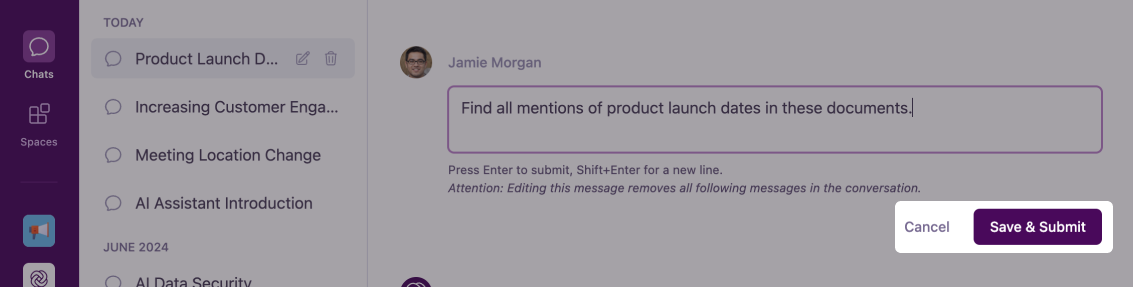 After making your changes, you have two options:
* Click "Save & Submit" to update your message and get a new response
* Click "Cancel" to discard your changes and keep the original message
Once you click "Save & Submit," your edited message will replace the original
one in the chat. Omnifact will then generate a new response based on your
edited message.
The AI assistant will generate a completely new response based on your
edited message. Any previous responses to the original message will be
removed from the conversation.
## Understanding the Impact of Editing
When you edit a message in Omnifact, it's important to understand what happens:
Editing a message effectively changes the conversation's history. Since the AI assistant's responses are directly related to what you asked, changing your question means the previous answers no longer match the new context. This is why Omnifact removes subsequent messages and generates a new response based on your edited message.
* **Edit when:** You want to clarify or refine your current question while maintaining the same general topic or focus.
* **Start a new chat when:** You're shifting to an entirely different topic or the conversation has progressed significantly and you don't want to lose that history.
## Best Practices for Editing Messages
Before editing, consider if a follow-up question might be more effective than
editing your original message. Sometimes adding clarification in a new message
preserves useful context from the AI's initial response. Learn more about
[Conversational Flow & Follow-Up Questions](/en/platform/core-features/chats/conversational-flow).
Make edits that genuinely improve your prompt or question, rather than making
minor changes that don't significantly affect the meaning.
Always pay attention to the warning about removing subsequent messages, and
only proceed if you're comfortable losing those responses.
If the AI's response contains valuable information you want to keep, consider
copying it before editing your message.
## Next Steps
Now that you understand how to edit your messages in Omnifact, you can:
* Learn about [Stopping and Regenerating Responses](/en/platform/core-features/chats/stopping-regenerating-responses) when you need to interrupt AI responses
* Discover how [the Privacy Filter](/en/platform/core-features/privacy-security/how-privacy-filter-works) protects your sensitive information
* Explore techniques for [Writing Effective Prompts](/en/guides/prompt-engineering/beginner/basic-structure) to get better results
After making your changes, you have two options:
* Click "Save & Submit" to update your message and get a new response
* Click "Cancel" to discard your changes and keep the original message
Once you click "Save & Submit," your edited message will replace the original
one in the chat. Omnifact will then generate a new response based on your
edited message.
The AI assistant will generate a completely new response based on your
edited message. Any previous responses to the original message will be
removed from the conversation.
## Understanding the Impact of Editing
When you edit a message in Omnifact, it's important to understand what happens:
Editing a message effectively changes the conversation's history. Since the AI assistant's responses are directly related to what you asked, changing your question means the previous answers no longer match the new context. This is why Omnifact removes subsequent messages and generates a new response based on your edited message.
* **Edit when:** You want to clarify or refine your current question while maintaining the same general topic or focus.
* **Start a new chat when:** You're shifting to an entirely different topic or the conversation has progressed significantly and you don't want to lose that history.
## Best Practices for Editing Messages
Before editing, consider if a follow-up question might be more effective than
editing your original message. Sometimes adding clarification in a new message
preserves useful context from the AI's initial response. Learn more about
[Conversational Flow & Follow-Up Questions](/en/platform/core-features/chats/conversational-flow).
Make edits that genuinely improve your prompt or question, rather than making
minor changes that don't significantly affect the meaning.
Always pay attention to the warning about removing subsequent messages, and
only proceed if you're comfortable losing those responses.
If the AI's response contains valuable information you want to keep, consider
copying it before editing your message.
## Next Steps
Now that you understand how to edit your messages in Omnifact, you can:
* Learn about [Stopping and Regenerating Responses](/en/platform/core-features/chats/stopping-regenerating-responses) when you need to interrupt AI responses
* Discover how [the Privacy Filter](/en/platform/core-features/privacy-security/how-privacy-filter-works) protects your sensitive information
* Explore techniques for [Writing Effective Prompts](/en/guides/prompt-engineering/beginner/basic-structure) to get better results